⏱️ Read time: 5 min
This week warrants an extra edition because a significant part of the EU AI Act is now coming into force. I also want to be upfront: I'm not a legal expert on the EU AI Act. This is informational content only, not legal advice. The EU AI Act is complex and enforcement is evolving. When in doubt, consult a lawyer.
This is also a longer edition than usual, but I think the stakes warrant it.
The Context For This Edition
As of August 2, 2026, the EU AI Act's disclosure obligations under Articule 50 are now live. If you're creating content with the help of AI (text, images, video, or audio), you need to understand who must disclose what, and when.
For content creators, marketers, and agencies working across the EU, the practical question is not whether you may use AI. It is whether the content you publish falls within a disclosure obligation, and whether a human has taken real editorial responsibility for it.
The Core Rule: Article 50
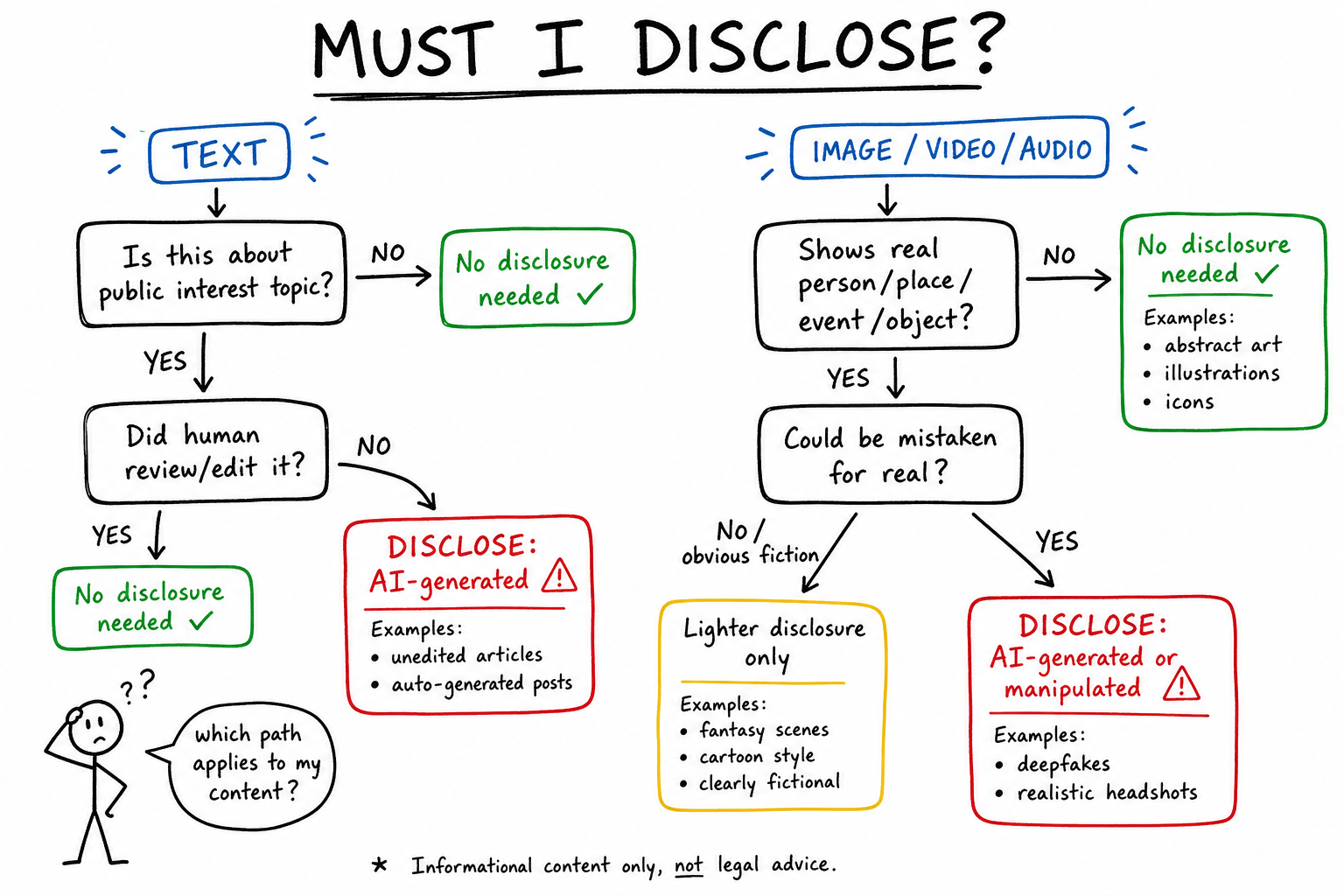
The decision tree is different for text and for images, video, and audio.
Text
The first question is: Does the text inform the public about a topic of public interest? This can include politics, elections, health, security, the environment, the economy, or law.
If the answer is no, think for example, a product description, an internal email, or a purely personal or entertainment-oriented piece, this specific public-interest text disclosure obligation does not apply.
If the answer is yes, ask: Has a human reviewed or edited the text, and has a person or organisation taken editorial responsibility for the publication?
If yes, the human editorial responsibility exception may apply. This is the model I recommend in practice: use AI to draft, structure, research, or challenge your thinking, but personally review, fact-check, edit, contextualise, and sign off on what goes out.
If no, if AI-generated text about a public-interest topic is published without meaningful human review or editorial control, disclosure is required.
Examples:
- An AI-generated article about election policy published without review: disclosure required.
- An AI-generated post about economic trends published as-is: disclosure required.
- An AI-assisted article that has been substantively reviewed, fact-checked, rewritten, and approved by a human editor: the human editorial responsibility exception may apply.
Images, video, and audio
The rules are stricter for visual and audio content.
Ask:
Does the content depict a real person, real place, real event, real organisation, or real object, and could it be mistaken for authentic?
Content that is clearly abstract, fantastical, stylised, or obviously fictional generally does not create the same deepfake disclosure issue. But realistic depictions of real people, places, events, organisations, or objects may need to be disclosed.
Examples include:
- An AI-generated image of a politician at a rally;
- A manipulated photograph of a real location;
- Generated audio that imitates a real person's voice;
- A realistic AI-generated headshot;
- A video that makes a real person appear to say or do something they did not.
For deepfake content, the disclosure should be clear, distinguishable, and available no later than the person's first exposure to it.
Artistic, satirical, or fictional content
This is not a blanket exemption. Artistic, satirical, and fictional deepfakes still require disclosure, but the obligation is lighter: the existence of the generated or manipulated content should be disclosed in an appropriate way that does not hamper the display or enjoyment of the work.
If you're in a grey area, if someone could reasonably mistake the content for real, I'd say disclose it clearly.
A Short Checklist
A disclosure should not be hidden in fine print. Use a clear statement, caption, label, or other human-perceivable notice. Machine-readable marking and metadata may also matter, but they are not a substitute for a visible disclosure where the law requires one.
Why The Human Should Always Lead
This goes beyond legal compliance. The way you use AI matters as much as whether you disclose it.
Many creators and marketers now use tools that can place content on social media, email funnels, and other channels on autopilot. These tools can be useful, but they should serve your judgement, not replace it. Automated publishing workflows should be clearly governed, and content generated or distributed without human sign-off should not be treated as business as usual.
My Approach Is Simple
The human should always be in the lead and in the loop. AI augments my work, but it does not replace my editorial responsibility.
In practice:
- Everything starts with context and intent. I define the point of view, audience, and goal before asking AI to generate anything.
- AI assists; I decide. I review, evaluate, modify, or reject every suggestion. Nothing gets published without my sign-off.
- Fact-checking is non-negotiable. I use my own AI-assisted fact-checking skill to speed up research, but I do a thorough manual review before anything goes public.
- I label AI-generated images. When I use AI to generate images of myself or other visual content, I label them as AI-generated because transparency builds trust.
- I track human involvement. I have built a skill that manages versioning and records where humans have reviewed and approved documents. That creates an auditable trail of human oversight.
This might sound like overkill. If you work with organisations, produce client documents, or use research in your work, it is not. It helps you stay thoughtful, prevents complacency, and gives you evidence of where human judgement was involved.
What To Do Now
- Focus on new content: From August 2, 2026 onwards, assess new AI-generated or AI-manipulated content before publishing.
- Update your templates: Add a disclosure check to your content approval workflow.
- Train your team: Make sure writers, designers, and marketers know when disclosure may be required.
- Document your process: Keep a record of meaningful human review, fact-checking, and approval.
- Be proactively transparent: Even where disclosure is not strictly required, a clear note such as “AI-assisted” can help build trust.
The Bottom Line
The EU AI Act is about about reducing deception and making sure people can understand when they are seeing or hearing synthetic content.
The safest practical approach is straightforward:
- Use AI to augment human judgement.
- Keep a human in the lead and in the loop.
- Review and fact-check before publishing.
- Disclose realistic synthetic media.
- When in doubt, disclose.
This overview covers Article 50 as of August 2, 2026. It is informational content only, not legal advice. Remember: for the latest updates, legal guidance, or industry-specific advice, check with your local data protection authority or consult a lawyer familiar with EU AI Act compliance.
Best,
Elena