⏱️ Read time: ~4 min
One of the most frequent questions I get from both my customers and prospective customers is about model choice: "How do I know which model to use?"
It's an understandable question. Six months ago the answer was more or less straightforward. Now there are countless serious models worth considering, and a new one seems to drop every week. Even people who use AI daily, people in my programs and communities, keep asking the same thing.
The honest answer used to be "use the best one available." Now it's "it depends," and that feels like a non-answer when you're trying to get work done.
But here's what I've learned from using AI in my business: the expensive model isn't always the best one for the task at hand. In fact, most people default to the wrong tier for 80% of what they do. And when AI is your constant sidekick, that choice compounds.
This is what this edition is about: answering that one question clearly. Which model should I use, and why?
Always ask yourself this one question first:
What am I trying to do?
- Everyday work: emails, summaries, simple content, classification, quick answers
- Production workloads: customer-facing applications, coding, analysis, complex writing
- Deep reasoning: strategy, architectural decisions, novel problem-solving, agentic work
Your answer determines which tier you need. Then you pick your provider (Claude or OpenAI or whatever your preferred AI Chatbot) based on what you're already using.
The Tier System
TIER 1: BUDGET / HIGH-VOLUME
Use this for: Classification, routing, extraction, fast summaries, bulk processing
Speed: Ultra-fast (150+ tokens/sec)
Quality: 80–85% of flagship capability
Cost: ~$1 per 1M tokens (input)
Energy: ~70x more efficient than reasoning models
Examples:
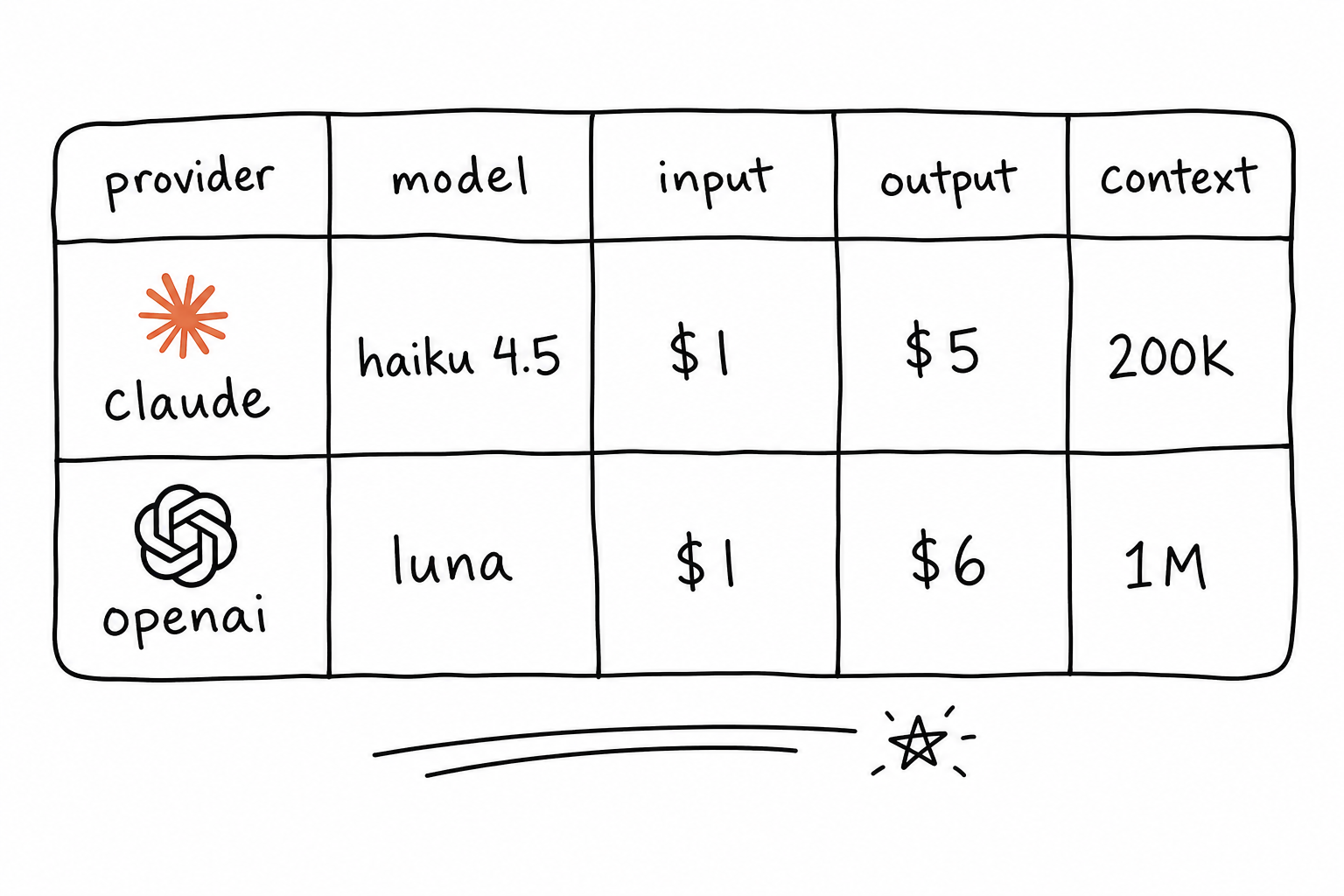
Real-world: You're processing survey responses, tagging them, pulling out key info, sending templated responses. Haiku crushes this. It's fast, it's cheap, and it doesn't need deep reasoning, it just needs to be reliable. Luna works too if you're on OpenAI. The speed difference matters when you're running large volumes.
TIER 2: PRODUCTION / EVERYDAY WORKHORSE
Use this for: Coding, customer-facing content, analysis, most business logic
Speed: Fast (50–100 tokens/sec)
Quality: 90–95% of flagship
Cost: $2–3 per 1M tokens (input)
Energy: ~5x more efficient than frontier models
Examples:
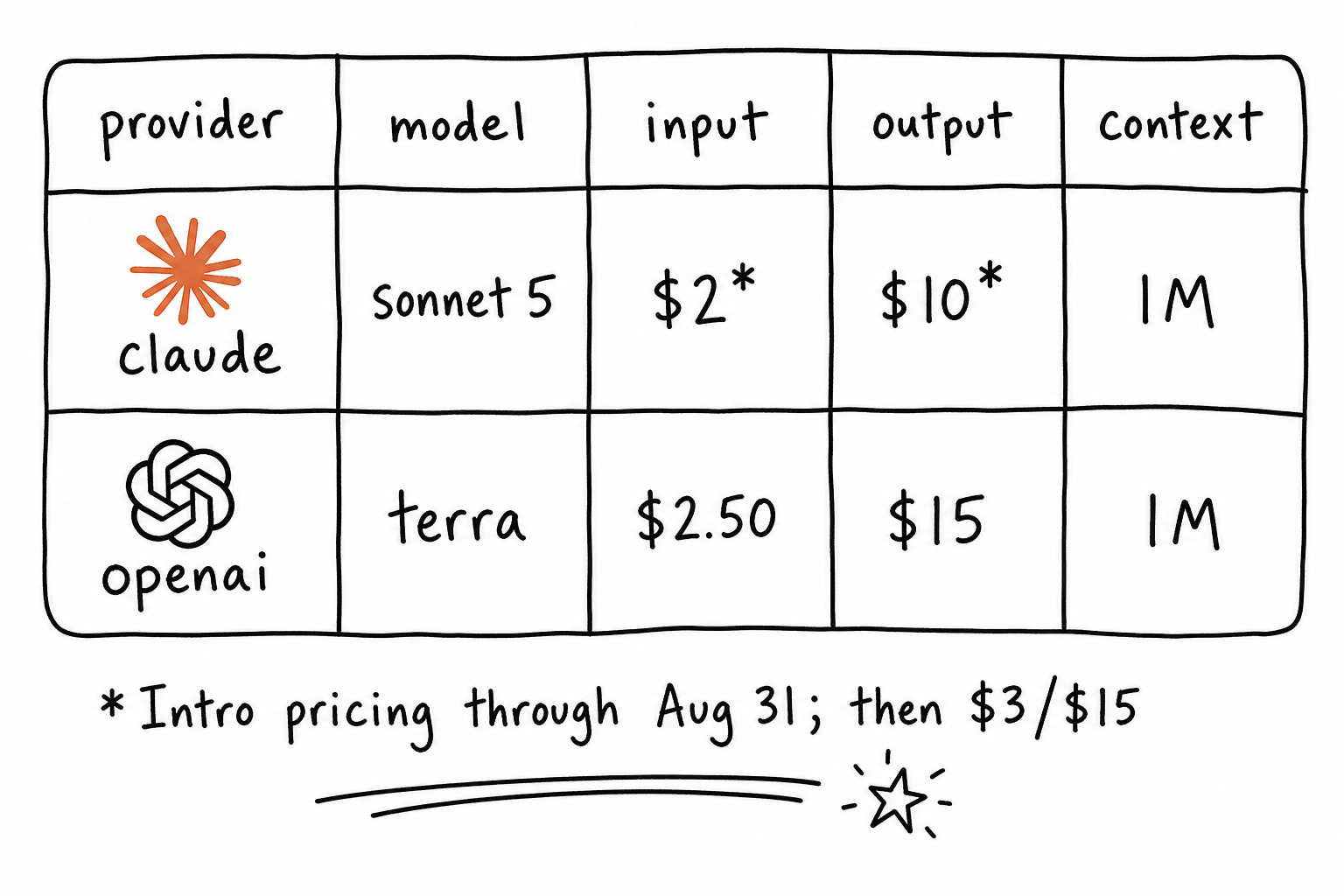
Real-world: You're drafting client proposals, writing email sequences for your course, creating content assets for your social media. Both Sonnet 5 and Terra excel at this. This is where most solopreneurs and coaches should live. You get 90% of the capability at a fraction of the cost of Tier 3.
TIER 3: FLAGSHIP / DEEP REASONING
Use this for: Agentic work, complex code review, strategy, multi-step planning
Speed: Moderate (20–50 tokens/sec)
Quality: Frontier capability (97–99%)
Cost: $5–10 per 1M tokens (input)
Energy: 10–15x more intensive than production models
Example:
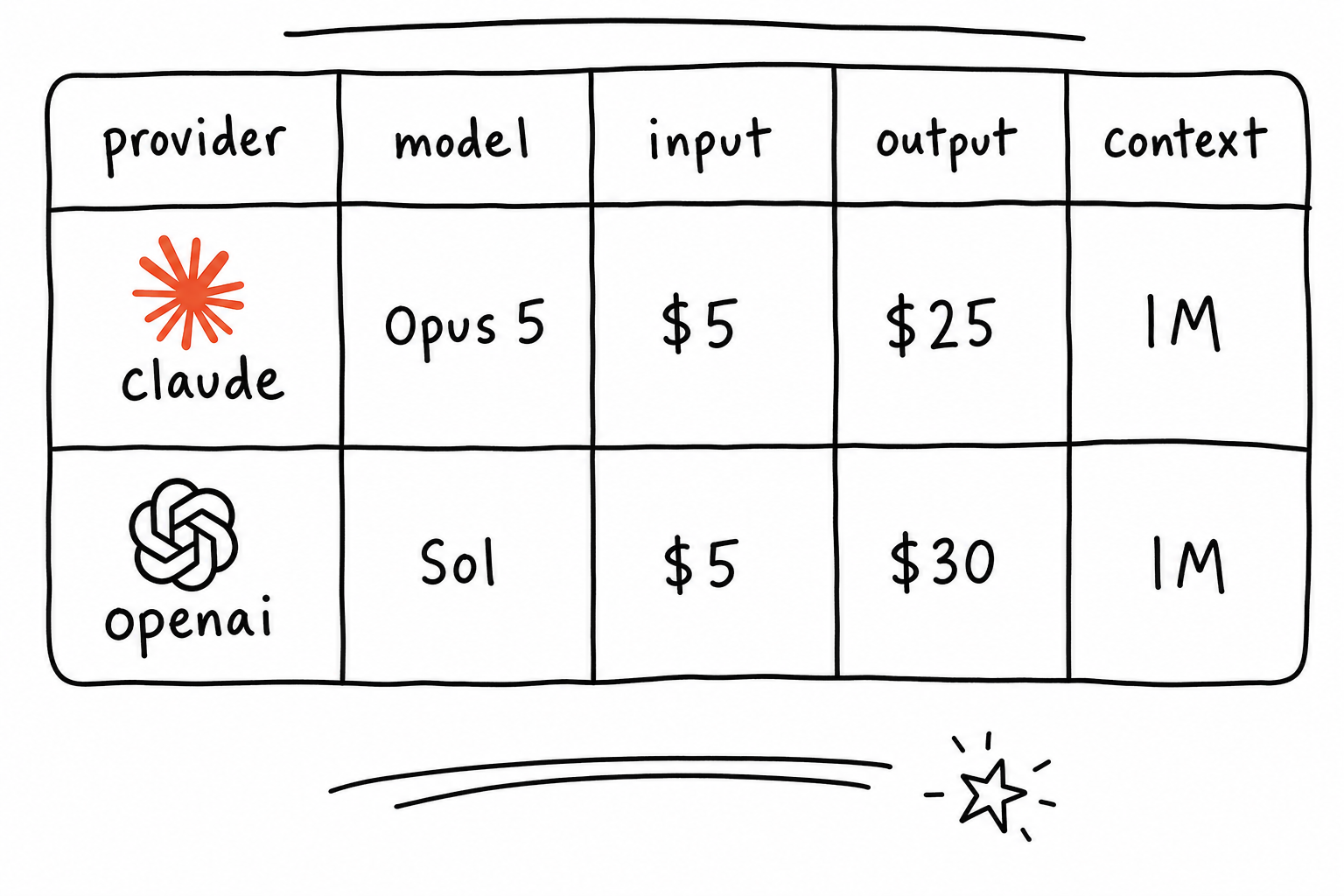
Real-world: You're planning a new product launch. You need to think through positioning, messaging, what problems it solves, who it's for. You're designing a new offer structure for your coaching business. You need a model that can hold complexity and help you reason through options. Both Opus 5 and Sol handle this beautifully. The cost math: you might use Tier 3 for 5–10 strategic projects a year. Run the rest through Tier 2. You've just cut your AI bill in half while keeping your best thinking intact.
Pro Tip: Switch to Sonnet 5 or similar once you have clarity on say the elements and sequencing of your product launch. That way you get the best of both worlds.
TIER 4: FRONTIER / AGENTIC
Use this for: Multi-day autonomous agents, novel research, highest-stakes work
Speed: Slow (sustained reasoning)
Quality: Best available (99%+)
Cost: $10–50 per 1M tokens
Energy: 100x+ more intensive per request
Example: Claude's Fable 5, which is Anthropic's most capable model. At a cost of 10 $ per 1 M input tokens and $50 per 1M output tokens, it's also Anthropic's most expensive model. Open AI currently doesn't have a model that compares.
Real-world: You're building a multi-day agent that researches your market, pulls together competitive analysis, synthesizes findings, and presents options for your next business move. Or you're running an agent that generates content variants, tests subject lines, optimizes offers—running 24/7 in the background. Fable 5 is built for this. It's expensive and at least as far as my testing has gone, I don't see it outperforming Opus 5 (I am sure it can but not for my use cases).
The Energy Angle, Research from 2026 shows:
- Claude Sonnet ranks highest in eco-efficiency (0.886 score) — strong reasoning per unit of energy
- Open AI's o3 (Sol's predecessor) and extended reasoning models are 70x more energy-intensive than small models
- Smaller models (Haiku, Luna) at 80–90% capability use 5–10% of the energy
Translation: If you default to Opus 5 or Sol for every task, you're burning roughly 10x more electricity and carbon per request than you'd need to. Routing work to the appropriate tier isn't just financially smart, it's environmentally responsible.
Summary: Which Tier for What?
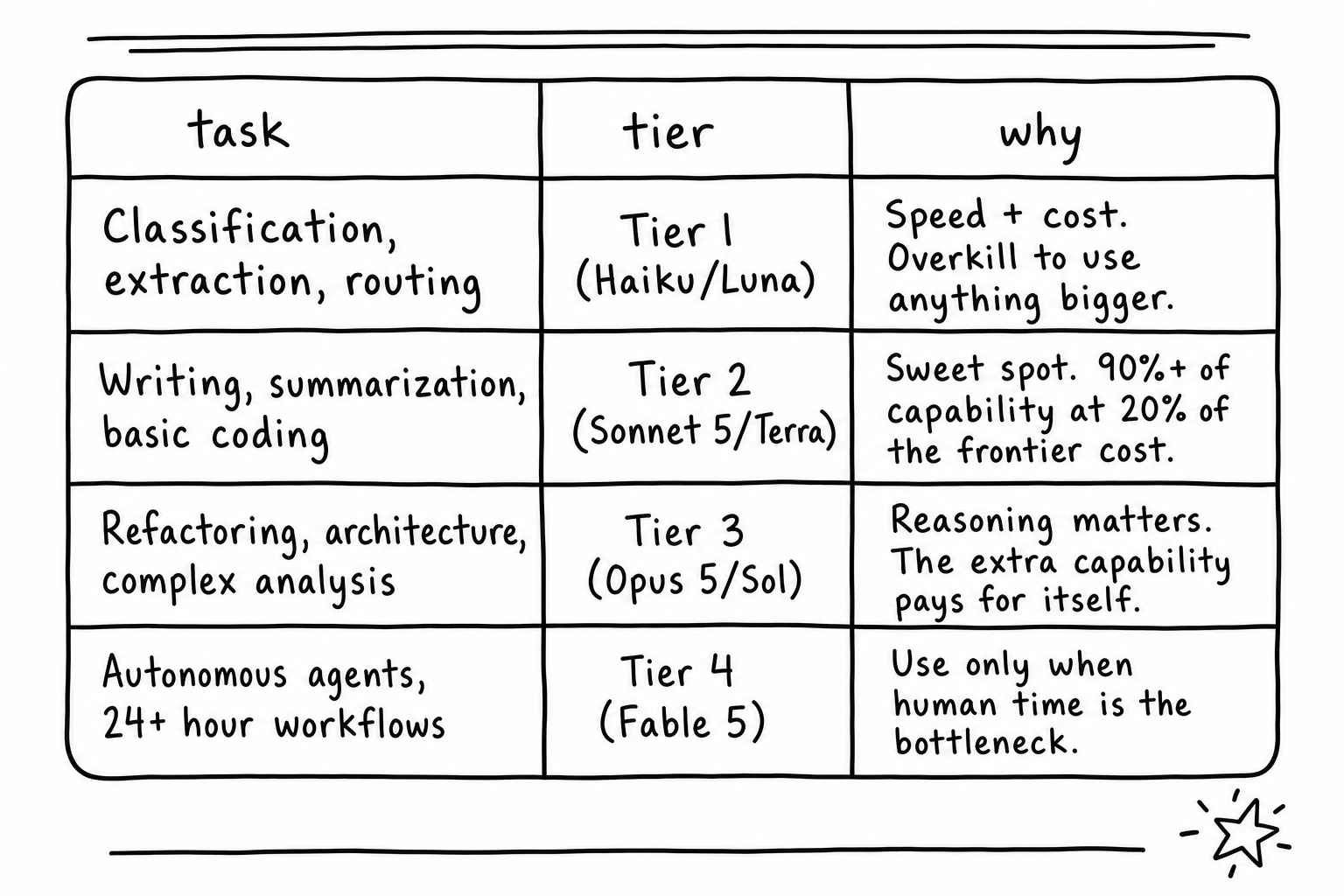
In other words, expensive doesn't mean best.
Here's how I actually work: Haiku 4.5 is my default in Langdock for everyday tasks. Not because it's always the right answer, but because defaulting to it prevents me from falling into the habit of going more expensive than I need to. It supports my repetitive work brilliantly. Writing this newsletter? Luna (previously Haiku). Summarizing? Luna or Haiku. Quick takes? Luna or Haiku. Website structures? Opus 5. Website Coding? Sonnet 5.
When I'm doing actual strategy or design work, I consciously switch models. When I'm running a team of agents, each one has the right model assigned from the start based on its focus. And even if I start with a flagship like Fable for the initial strategy work, I switch to a more efficient model once the heavy thinking is done.
The pattern: Start lightweight. Prove you need more. Switch intentionally. Don't waste flagship compute on work that doesn't need it.
One more thing: the model you pick is a design decision, not a status symbol. The best AI team isn't the one using the most expensive model, it's the one conscious enough to pick the right one for each job, structure prompts well, give AI real context, and engage in actual dialogue.
One Final Reality Check
"I'm on OpenAI but I heard Claude is better, should I switch?"
No.
The models are different, but not different enough for everyday users to notice. Sonnet 5 and Terra are competent at the same tasks. Opus 5 and Sol solve the same problems. The real difference isn't which tool you pick, it's how you use it.
What actually moves the needle:
- Picking the right tier for the task (not the most expensive one)
- Structuring your prompts well
- Giving AI the right context
- Engaging in a real dialogue instead of one-shot requests
If you're already efficient with Claude, stay with Claude. If you're already efficient with OpenAI, stay with OpenAI. Switching providers because you heard one is "better" is missing the actual lever.
The difference you'll feel comes from using the right model for the right job with the right context, not from switching ecosystems.
Make sense?
Go try it...
Elena